Who Was Al-Khwarizmi? The Father of Algebra Explained
Who was al-Khwarizmi? A short biography of the Baghdad scholar, his algebra book, his contribution to mathematics and how his name gave us the word algorithm.
Every time you search the web or open an app, you rely on “algorithms”, a word that carries the name of a man who lived in Baghdad more than 1,100 years ago. So who was al-Khwarizmi? He was the scholar whose book gave algebra its name, who helped spread the Hindu-Arabic decimal numerals, and whose own name became a basic term of computer science.
Who was al-Khwarizmi? A short biography
His full name was Abu Ja’far Muhammad ibn Musa al-Khwarizmi, a mathematician, astronomer and geographer. He was born around 780 CE and died around 850 CE. These dates are approximate, because early sources record very little about his personal life.
| Fact | Details |
|---|---|
| Full name | Abu Ja’far Muhammad ibn Musa al-Khwarizmi |
| Lived | c. 780 – c. 850 CE |
| Worked in | Baghdad, at the House of Wisdom |
| Best-known book | The Compendious Book on Calculation by Completion and Balancing |
| Fields | Mathematics, astronomy, geography |
| Known as | The father of algebra |
Where was al-Khwarizmi from?
The name “al-Khwarizmi” points to Khwarazm, a historical region of Central Asia around the delta of the Amu Darya river, roughly in today’s Uzbekistan and Turkmenistan. Historians believe he or his family came from there, but he lived, worked and wrote in Arabic in Baghdad, the capital of the Abbasid state at the time.
Al-Khwarizmi at the House of Wisdom
Al-Khwarizmi worked at the House of Wisdom in Baghdad under the Abbasid caliph al-Ma’mun (who ruled roughly 813–833). The House of Wisdom was a centre where Greek, Indian and Persian works were translated into Arabic and where scholars gathered to research and write.
Sources say he dedicated some of his works to al-Ma’mun, including his book on algebra. In this setting he drew on the knowledge of earlier civilisations and added a new, systematic approach.
Al-Khwarizmi’s algebra: why is he called the father of algebra?
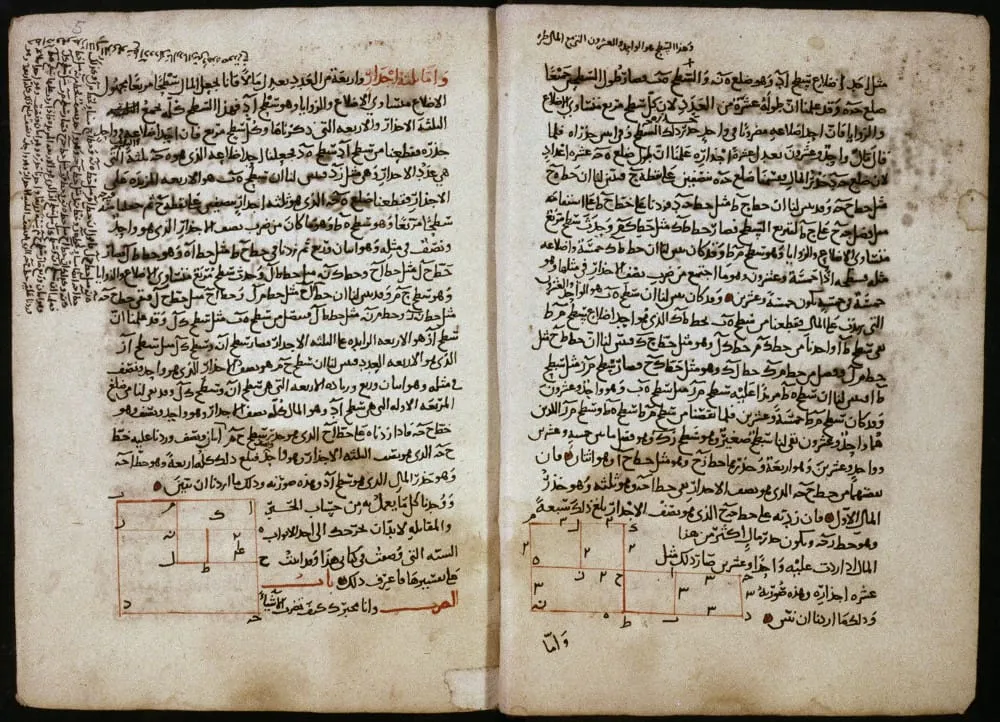
His most famous work is al-Kitab al-mukhtasar fi hisab al-jabr wal-muqabala, usually translated as The Compendious Book on Calculation by Completion and Balancing, written in the first decades of the 9th century. In it he:
- Set out systematic rules for solving linear and quadratic equations, sorting them into six standard types.
- Explained the solutions in words and with geometric proofs, since modern symbols like x and y did not yet exist.
- Devoted much of the book to practical problems, such as trade, land measurement and dividing inheritances arithmetically.
Al-jabr means “completion” or “restoring”: moving a subtracted term to the other side of an equation. Al-muqabala means “balancing”: cancelling equal terms on both sides. The English word algebra comes from al-jabr in the title.
Did you know? Al-Khwarizmi’s algebra was translated into Latin by Robert of Chester in 1145, and again soon after by Gerard of Cremona. It remained an important mathematics textbook in Europe for centuries.
From al-Khwarizmi to “algorithm”
Al-Khwarizmi also wrote a book on arithmetic with Indian numerals, explaining place value, the use of zero, and methods for adding, subtracting, multiplying and dividing. The Arabic original is lost, but a Latin translation survives, opening with the words “Dixit Algorizmi” (“al-Khwarizmi said”).
His Latinised name, Algoritmi or Algorismus, gave rise to algorism, meaning calculation with decimal numerals, which later became algorithm: a precise, ordered set of steps for solving a problem. That idea sits at the heart of programming today.
The book also helped bring the digits we use today to Europe; read the full story in our article on where Arabic numerals come from.
Al-Khwarizmi’s contributions to astronomy and geography
His achievements went beyond mathematics:
- Astronomy: he compiled the Zij al-Sindhind, a set of astronomical tables for calculating the positions of the sun, moon and planets, drawing on Indian and other sources. The Arabic original is lost; what survives is a Latin translation of a revised version, made by the English scholar Adelard of Bath in the early 12th century.
- Geography: his Kitab Surat al-Ard (The Image of the Earth) lists the longitude and latitude of about 2,400 places, including cities, mountains, islands and rivers. It built on the work of the Greek geographer Ptolemy and corrected some of his errors. His maps did not survive, but modern scholars have reconstructed some of them from his descriptions.
Al-Khwarizmi’s legacy today
- The words algebra and algorithm exist in languages around the world because of him.
- His arithmetic book helped spread the decimal system we write numbers in today.
- Universities, schools and science prizes carry his name, and a crater on the Moon is named after him.
He belongs to a line of great scholars of the Arab and Islamic world, alongside Ibn Sina in medicine and Ibn al-Haytham in optics.
Frequently asked questions
What was al-Khwarizmi famous for?
He is best known for founding algebra as a discipline with his book al-jabr wal-muqabala, for explaining arithmetic with Hindu-Arabic numerals and zero, and for giving his name to the word algorithm.
What was al-Khwarizmi’s contribution to mathematics?
He gave systematic methods for solving linear and quadratic equations, presented algebra as its own subject, and helped spread the decimal place-value system that the whole world uses today.
What books did al-Khwarizmi write?
His main works are the algebra book (al-Kitab al-mukhtasar fi hisab al-jabr wal-muqabala), a book on Indian arithmetic known through its Latin translation, the astronomical tables Zij al-Sindhind, and the geography Kitab Surat al-Ard.
Why is an algorithm named after al-Khwarizmi?
Because his Latinised name, Algoritmi, became the word for calculating with decimal numerals, and over time “algorithm” came to mean any step-by-step procedure for solving a problem.
Key takeaway
Al-Khwarizmi, a scholar of Baghdad’s House of Wisdom, founded algebra, helped spread decimal numerals and zero, and contributed to astronomy and geography. Because his name became the word “algorithm”, his legacy lives on in every computer and phone we use.